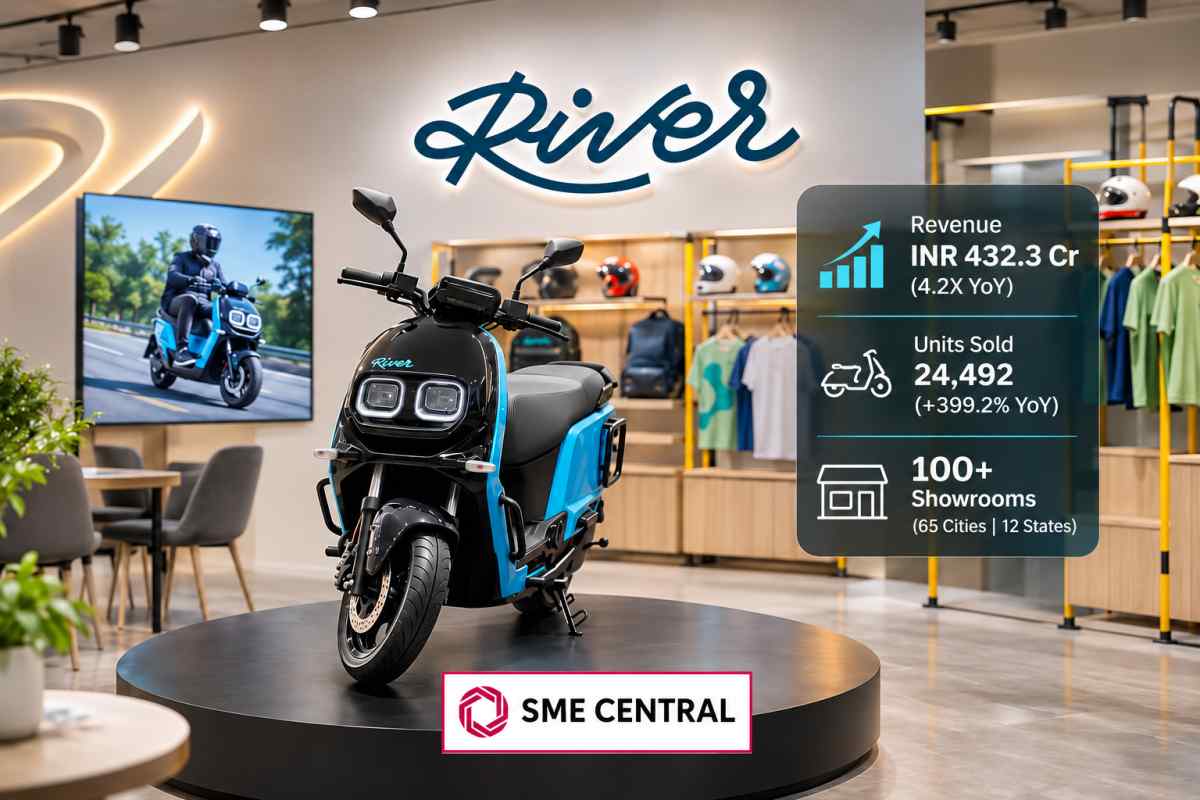
Bengaluru-based electric two-wheeler manufacturer River Mobility has delivered a sharp top-line inflection in the financial year ended 31 March 2026 (FY26), with operating revenue surging 4.2X year-on-year (YoY) to INR 432.3 Cr, up from INR 101.9 Cr in FY25.
While the bottom line remained in the red—with net losses widening 46% YoY to INR 285.7 Cr from INR 195.7 Cr—the underlying financial metrics point to improving operating leverage. Revenue growth significantly outpaced the 140.1% rise in total expenses, signaling that the company is beginning to absorb its fixed overhead costs as production and retail volumes scale.
Backed by a fresh USD 120 million Series C war chest closed in August 2026 and a rapidly expanding dealership footprint that recently crossed the 100-showroom mark, River Mobility is positioning itself as a differentiated, utility-first challenger in India’s crowded electric two-wheeler (E2W) landscape.
River Mobility FY26 Financial Performance
River Mobility’s FY26 financials reveals a classic capital-intensive manufacturing scale-up. Including other income, total income rose 317.5% to INR 433.4 Cr in FY26, compared to INR 103.8 Cr in the previous fiscal.
| Metric (in INR Cr) | FY25 | FY26 | YoY Change (%) |
| Operating Revenue | 101.9 | 432.3 | +324.2% |
| Total Income | 103.8 | 433.4 | +317.5% |
| Total Expenses | 299.5 | 719.1 | +140.1% |
| Net Loss | (195.7) | (285.7) | +46.0% |
| Operating Cash Outflow | (160.1) | (235.5) | +47.1% |
| EV Units Sold (Vahan/Annual) | 4,906 | 24,492 | +399.2% |
The Unit Economics Shift
The headline widening of losses masks a substantial improvement in unit-level efficiency:
- Cost-to-Revenue Compression: In FY25, River Mobility spent INR 2.94 to generate every INR 1 of operating revenue. By FY26, that ratio compressed sharply to INR 1.66 per INR 1 of revenue.
- Margin Recovery: Net loss margin as a percentage of operating revenue narrowed from -192.1% in FY25 to -66.1% in FY26.
- Revenue Mix: Core sales of the flagship Indie electric scooter—including government subsidies—contributed INR 353.4 Cr (81.7% of operating revenue), up from INR 81.3 Cr in FY25. Notably, high-margin service revenue, primarily driven by the design and development of prototypes, more than tripled to INR 57.7 Cr from INR 18.1 Cr, providing a useful secondary revenue cushion.
Inside the Expense Bill
Total expenditure climbed to INR 719.1 Cr in FY26 from INR 299.5 Cr in FY25, driven primarily by volume-linked procurement and product pipeline investments.
| Expense Head (in INR Cr) | FY25 | FY26 | YoY Change (%) | % of FY26 Op. Revenue |
| Raw Material Costs | 115.0 | 404.1 | +251.4% | 93.5% |
| Employee Benefit Expenses | 75.5 | 110.9 | +46.9% | 25.7% |
| Vehicle Testing Expenses | 19.4 | 48.5 | +150.0% | 11.2% |
| Advertising & Promotion | 13.0 | 28.3 | +117.7% | 6.5% |
Key Cost Takeaways:
- Material Cost Efficiency: Raw material costs grew 251.4% against a 324.2% jump in operating revenue. In FY25, raw material costs alone exceeded operating revenue (112.9%); in FY26, they dropped below revenue (93.5%), indicating better supplier pricing power and bill-of-materials (BoM) optimization.
- Fixed Cost Absorption: Employee benefit expenses fell from 74.1% of operating revenue in FY25 to 25.7% in FY26, demonstrating strong operating leverage on corporate and R&D headcount.
- R&D and Brand Building: The 150% surge in vehicle testing costs to INR 48.5 Cr reflects River’s active preparation for new model launches beyond the Indie, while advertising spend remained disciplined at 6.5% of operating revenue.
- Cash Burn Watch: Net cash outflow from operating activities rose 47.1% to INR 235.5 Cr from INR 160.1 Cr, underscoring the working capital intensity of scaling EV manufacturing and inventory.
Sales Momentum & Market Positioning
Founded in March 2021 by Aravind Mani and Vipin George, River Mobility launched the Indie—marketed as the “SUV of scooters” for its utility-first design—in February 2023 and commenced deliveries in October 2023.
Annual sales jumped nearly 5X to 24,492 units in FY26 from 4,906 units in FY25. That momentum has carried firmly into FY27:
- According to Vahan registration data, River Mobility stood as India’s seventh-largest E2W maker in October 2026 with a ~3% market share.
- Monthly registrations climbed 15.7% month-on-month (MoM) to 6,533 units in October 2026, up from 5,647 units in September 2026.
At an annualized run rate now exceeding 78,000 units based on October registrations, River is steadily closing the gap with mid-tier rivals while maintaining a higher average selling price (ASP) than mass-market commuters.
Retail Blitz: 100 Showrooms Crossed, Eyes on 200 by March 2027
Distribution is a critical moat in India’s two-wheeler market, and River Mobility has accelerated its offline rollout aggressively. On 30 October 2026, the company crossed the 100-showroom milestone within three years of commercial operations by opening 10 outlets in a single day across five states—spanning Delhi, Lucknow, Agra, Udaipur, Ajmer, Chennai, Puducherry, Navi Mumbai, Pune, and Visakhapatnam.
- Current Footprint: 100+ showrooms across 65 cities and 12 states, offering integrated sales, test rides, accessories, merchandise, and after-sales service.
- Near-Term Targets: 150 stores by the end of calendar year 2026, 200+ outlets by March 2027, and 350 to 400 outlets by March 2028.
- International Debut: River has also initiated its global expansion with an entry into Kathmandu, Nepal, testing export demand in neighboring South Asian markets.
Read Also: Sweet Chain Shree Anandhaas Raises ₹110 Cr, Valuation Jumps 3.3x to ₹1,908 Cr
Capital Runway and the Path to Breakeven
To fund this dual push in manufacturing and retail, River Mobility closed a USD 120 million (~INR 1,141 Cr) Series C round in August 2026, comprising equity and venture debt. Co-led by Elev8 Venture Partners and Claypond Capital, the round marked River’s first major backing from Indian institutional investors, alongside participation from existing strategic backers including Yamaha Motor, Al-Futtaim, and Mitsui. Prior to this, the company had raised USD 68 million, including a USD 40 million round led by Yamaha Motor.
Capital Deployment & Breakeven Math:
- Capacity Expansion: Funds are earmarked for scaling the existing Hoskote facility near Bengaluru and constructing a new greenfield manufacturing plant, alongside developing new models in the utility-lifestyle segment.
- Profitability Horizon: At its FY26 operating cash burn of INR 235.5 Cr, the USD 120 million raise provides a multi-year liquidity runway. However, profitability remains a function of scale. While CEO Aravind Mani previously indicated an EBITDA breakeven threshold of 15,000–20,000 units per month, more recent management commentary pegs full operational breakeven at 25,000 monthly units, targeted around Q1 or Q2 FY29.
With monthly registrations currently at 6,533 units, River Mobility will need to nearly quadruple its monthly volume over the next 24 to 30 months. Its ability to execute its second factory, launch follow-up models without diluting its utility-brand positioning, and maintain service quality across 200+ showrooms will determine whether its FY26 revenue inflection translates into sustainable profitability.